Blog


Ghost Bat (Macroderma gigas)
23 August, 2009

This spectacular beast must be the one of the Pilbara’s most intriguing creatures. Ghost Bats spend their days hanging from the roof of deep caves and adits, taking flight at night when they stretch their massive wing span of up to 500 mm. Their iniquitous look is matched only by their brutal feeding habits that include prey such as birds, frogs, lizards and other bats from their own cave. This brilliant white assassin of the night uses its large eyes and ears to locate prey. 

Environmental consultants often miss Ghost Bats during surveys due to their roosting behaviour deep within caves often inaccessible to humans. They are also often missed during Anabat recording as they do not make their echolocation call continuously. The best way to confirm this species presence is to locate scat piles near the entrance of the cave or to wait a distance from the cave at sunset and see if they emerge. Ghost Bats will generally leave the cave just after sunset or within the hour that follows.

gb

Photo: Carly Bishop


Malleefowl (Leipoa ocellata)
26 April, 2009

Malleefowl are members of the megapodiidae family along with other Australian “mound builders” such as the Orange-footed Scrubfowl and the Australian Brush-turkey. These birds are known for their nesting behaviour that includes the construction of large mounds of vegetation and dirt (see photo below) in which the female places its eggs.

_mg_1041

In thick, remnant vegetation in the Murchsion, Gascoyne and Goldfields it is not uncommon to come across a raised circle of dirt that was once a Malleefowl mound. Due to clearing associated with agriculture, the areas where this species was once common have been reduced to small, often disconnected patches of habitat (fragmentation). To determine if this species is in the area a survey is undertaken to find active Malleefowl mounds. This includes identifying appropriate habitat from aerial photography then walking transects through these areas on foot. Mounds discovered are measured (width, depth, height and crater width, depth and height) and rated to determine how recently the mound has been used. Environmental consultants also look for Malleefowl tracks that can be positively identified by someone with the appropriate experience (see photo below).

For more information visit the Mallefowl Preservation Group website.

_mg_1106

Mallefowl are listed as Vulnerable under the Federal EPBC Act and Schedule 1 under the West Australian Wildlife Conservation Act.


Small Mammals and Pads
1 April, 2009

Dunnart species are notoriously difficult to differientiate in the field. In the Pilbara and Murchison regions there is evident and theoretical overlap between numerous species such as:

  • Stripe-faced Dunnart (Sminthopsis macroura);
  • Fat-tailed Dunnart (Sminthopsis crassicaudata);
  • Hairy-footed Dunnart (Sminthopsis  hirtipes);
  • Lesser Hairy-footed Dunnart (Sminthopsis youngsoni);
  • Ooldea Dunnart (Sminthopsis ooldea); and
  • Long-tailed Dunnart (Sminthopsis longicaudata).

To determine the difference between species you often need to use more than one distinguishing characteristic. Characteristics such as:

  • Colour of upperparts, cheeks, fur, chin, tops of feet;
  • Tail length;
  • Ear shape; and
  • Arrangement of feet pads.

Foot pads are the best characteristic when determining Striped-faced Dunnart in Pilbara. For this species the interdigital pads are joined but not fused and you can generally see an arrangement of three enlarged callous knobs in the middle of each interdigital pads. The photos below are of a Fat-tailed Dunnart (last two photos)  and a Desert Mouse (first two photos).


_mg_0944

_mg_0935

_mg_0950

_mg_0955


Motion Sensitive Cameras
31 March, 2009

Biologic recently tested out a motion sensitive camera that has been designed for long term monitoring in rugged conditions. Motion sensitive cameras can be used to detect cryptic species that may not be detected by traditional survey methods. These cameras could be valuable for the detection of species such as Night Parrots, Bilbies, Mulgara and other rarely seen nocturnal animals. The specific model under review is capable of up to six weeks of operation without the need for battery replacement.

The photos below were taken during a four day trial period at a water trough near Weeli Wolli springs. As this technology becomes more reliable and less costly it could become a standard tool for environmental consultants.

mdgc0611


mdgc0809

mdgc0032


Knob-tailed Gecko – Nephrurus wheeleri
23 February, 2009

This amazing shot of a Knob-tailed Gecko, like most of the shots on this blog was taken by Dean Bradshaw. This gecko belongs to the genus Nephrurus and appears to be a characature or cartoon drawing of a gecko. This genus is endemic to Australia and characterised by a large head and a short tail terminating in a knob.

knobtailed


knobtails


Legless lizard – Delma fraseri


The little guy in the photo below is a legless lizard captured during a fauna survey in arid WA.

It belongs to the Pygopod (translates to flap-footed) family, and its scientific name is Delma fraseri. Members of the Delma genus can sometimes look quite similar and require a closer look at the scale arrangement on the head and body.

Delma fraseri is characterised by fewer than 18 mid-body scales. It also has its fourth supralabial scale under its eye, which can be seen in the photo. The labial scales form the upper lip and are counted from the rostrum scale (the rostrum is scale at the tip of snout and can also be seen in the photo).

fraser


Lucky (Thorny) Devil
14 February, 2009

Hundreds of thousands of reptiles die on the seemingly never-ending stretches of tar which dissect the Australian outback. Snakes and Lizards drawn to the warm surface in the morning and evenings, especially during spring, coming up short against the numerous road trains and other vehicles making long journeys between towns.

 This individual, a Thorny Devil (Moloch horridus), was lucky enough to intersect our path, and we managed to move her out of the way of a road train which passed a few minutes later. 

moloch


Scorpion Tail


The scorpion’s sting, located at the tip of what is known as the ‘metasoma’, comprises two major parts. At the base of the sting is a swollen area known as the telson. This contains the two venom glands. The rear part of the telson forms a sharp stinger called the aculeus.

The sting apparatus functions like a hypodermic needle. Two ducts run from the venom glands to openings in the tip of the aculeus. When the scorpion stings, muscles press the venom glands against the wall of the telson, squeezing venom through the hollow aculeus into the wound. This process is under the voluntary control of the scorpion, and the scorpion is capable of stinging without injecting any venom if it so chooses.

On close inspection of this photo, it appears that this particular scorpion, found crossing the sandy road in Francois Peron National Park, was quite ready to go all out and inject a tiny drop of venom – a shining transparent globule visible at the tip of the aculeus.

scorpion


Anabat Technology
13 February, 2009

Bioacoustics and the study of animal calls – encompasses everything from the howl of a wolf to the trumpeting reverberations made by elephants. One of the most fascinating things about this sphere of biology is that scientists are only beginning to understand the complicated language of animals which until recently remained undetectable and mysterious thanks to our relatively meagre sense of hearing.

Bats are one such example, a group famous for their remarkable sense of echolocation – which for the most part is based on acoustic signals far outside the frequency range that we as humans can detect. What is amazing is that with current technological advancements, it is now possible for field biologists to relatively easily measure and records these calls, translating a whole frequency of acoustic signals to a measurable staccato which can then be analysed in a laboratory, and even be made audible to our own ears. Much like the unique calls of different species of birds, what scientists have come to to understand is that each species of bat emits a unique series of ‘notes’ (which make up the ‘call’) – a fact that can then be exploited by field biologists who need to survey and identify bat species in their studies.

As part of a wildlife survey in the remote Pilbara region of Western Australia, our job is to find and identify all the animal species in the area – bats included. Until recently, bats could only be identified by the labour intensive process of mist-netting, whereby bats are actually captured and identified (by their unique genital structure, but that’s another story!). Using the ANABAT recorders means that this practice can be avoided, and species can be identified based on their unique call structure. The ANABAT recorders are left overnight in areas where bats are thought to be active (Caves, Rocky outcrops, Rivers, Water bodies etc.) and the recordings are analysed by experts back in Perth.

anabat


Pilbara Olive Python (Liasis olivaceus barroni)
8 February, 2009

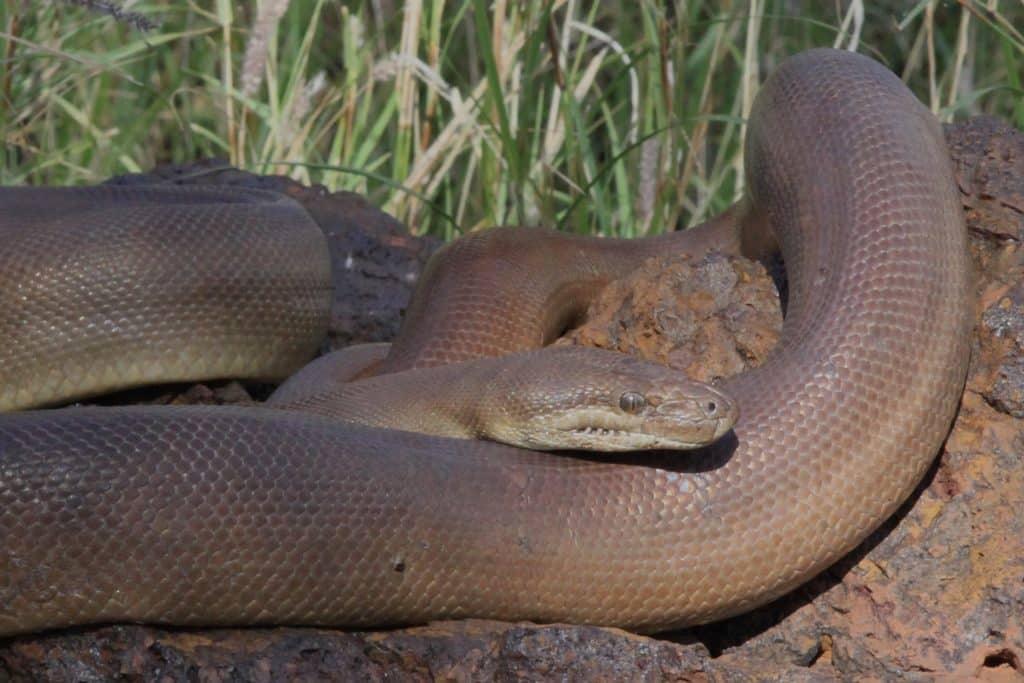
This large Pilbara Olive Python was seen while camping at one of the waterholes north of Newman. Other nocturnal visitor’s to this rockpool included Rothschild’s Rock Wallaby (Petrogale rothschildi), Stimson’s Python (Antaresia stimsoni), Spotted Rock Dtella (Gehyra punctata) and the Desert Tree Frog (Litoria rubella).

This Olive Python is well known to Newman locals, and is commonly seen at the rock pool. It most likely feeds on the Rothschild Rock-wallabies, which are plentiful at this location.

Below are some more details on this significant species.

mime-attachment-1

Taxonomy

The olive python was first discovered in northern Australia, and described by as Liasis olivaceus Gray (1842). This was later reclassified as L. o. olivaceus. A disjunct population of Olive Python living in the Pilbara region was described by Smith (1981) as L. o. barroni. The Pilbara olive python is endemic to Australia but has distant relatives living in Indonesia and New Guinea.

Significance

The Pilbara olive python is listed as Vulnerable under the Federal Environment Protection and Biodiversity Conservation Act 1999 (EPBC Act). This species is listed Schedule 1 under the WA Wildlife Conservation Act 1950 (WCA). Schedule 1 is described as fauna that is rare or likely to become extinct.

Description

The Pilbara olive python is one of Australia’s largest snakes, growing up 6.5 m (Wilson et. al., 2008). The upper surface is a dull grey / olive colour that at times appear to shimmer, while its ventral surfaces are white to cream.

Distribution

The Pilbara olive python is restricted to gorges and escarpments of the Pilbara and Gascoyne region (Wilson et al., 2008). They occur from the Burrup Penisula, Ord Ranges and Meentheena south to Nanutarra and Newman (Storr et al., 2002).  A recent discovery of a sub-adult python was made approximately 70 km east of Port Hedland at the site of the proposed Pardoo Iron Ore shipping facility.

Habitat

The Pilbara olive python is primarily found in gorges and dissected drainage lines. Recent radio tracking has shown that individuals are usually in close proximity to water and rock outcrops (DEWHA, 2008). Home ranges are generally restricted, but large distances can be traveled in the search for mates. This species has also been recorded up on top of large ridges.

p1040266

Â